I won’t go so far as to say that I’ve had a nuanced understanding of the pitfalls of capitalism since I was a young boy, but I can say definitively that, whether I’ve understood it or not, I’ve always found satire of capitalism to be inherently funny. Sure, I did the thing all young kids do, and laughed along with my parents until they explained something or (rarer) I figured it out on my own. But in between all that I was trying super-hard to be an adult, at least in comedy terms, so anything that made fun of something I recognized meant that I was instantly in on the joke, since that’s how comedy works.
Recognition is, oddly, just as functional in adult comedy, where “reference humor” now often means simply saying the name of a thing in place of a joke. Usually there’s some mutually-understood context between the author and the audience – this is how memes work, too – but there are also plenty of times when someone is just saying a thing they know people will recognize, and that gets laughs, too, for better or worse.
So when I tried like HELL to understand Doonesbury as a 12-year-old, the one thing I latched on to immediately was the character of Mr. Butts, an anthropomorphic cigarette. While I was admittedly slow to understand irony as a boy, this was markedly easy to grasp, and this walking product with old-style cartoon eyes stuck with me. Doonesbury is not the comic I’m here to talk about today because, of course, it is not a comic book. I could go on about the Jimmy Thudpucker vinyl records I have because of an obsession with vinyl comedy, or the fact that Garry Trudeau is at least somewhat familiar with my own political satire, but that’s not what this is about. It’s about ego.
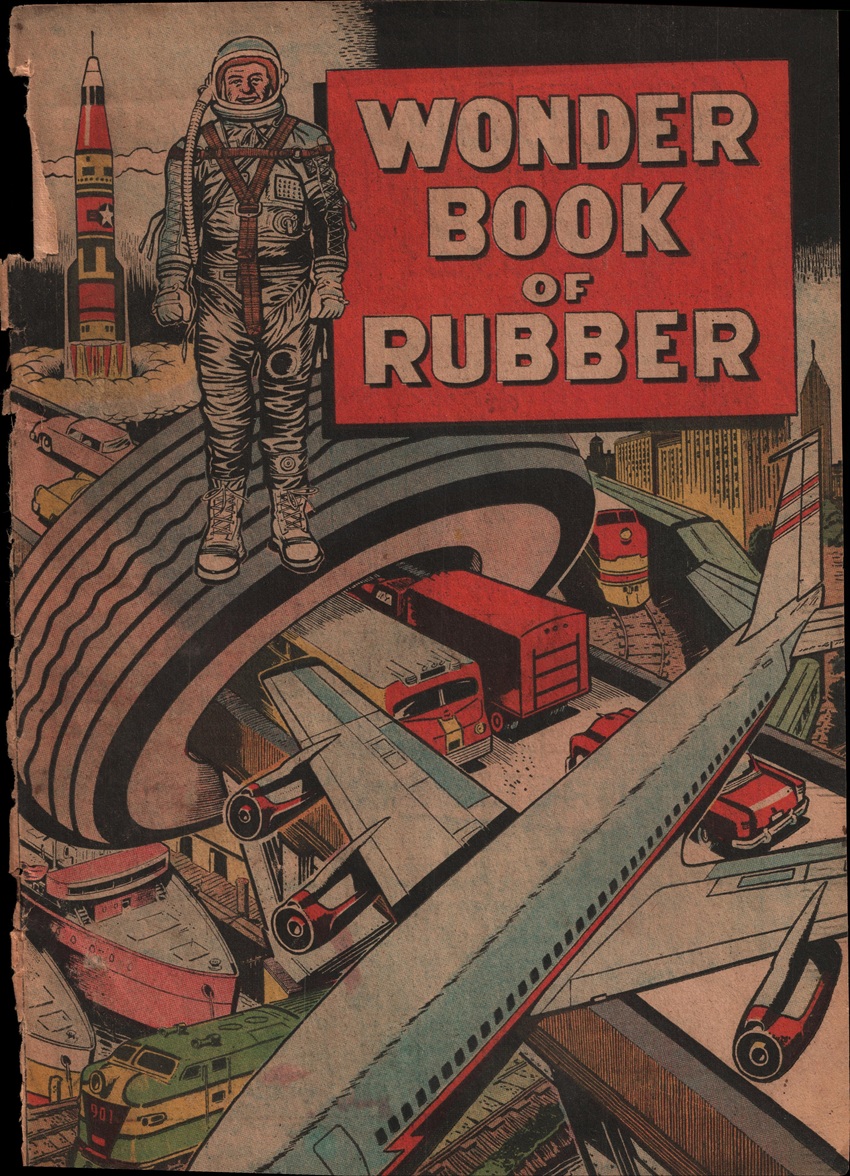
If you’ve never read Wonder Book of Rubber, you maybe weren’t in a 1990 classroom flipping through piles of old corporate ads and propaganda that took the form of comic books printed from cover to cover on pulp. We could take however many of these we wanted home. No one did. Except my best friend Dan and I. Something – the title probably – struck us as inherently funny – I mean, the word “rubber” was right there and we knew (vaguely) what a condom was. There was also something funny I wouldn’t have been able to articulate about outdated things insisting they are important. It’s the “white man ethos,” and we were only a puberty away from being a part of it ourselves.
Wonder Book of Rubber didn’t necessarily inspire us to later try and make our own comic books in junior high study hall, but there’s a piece of it in there. It’s a long, drawn-out, colonialism-pilled story of how Columbus “borrowed” rubber from indigenous Americans and how eventually corporations made the future happen with it. Specifically, B.F. Goodrich.
I’m pretty sure I knew propaganda when I saw it, because I’ve always known, deep down, that these things are funny. “THEN CAME AGGRESSION IN KOREA!” And it follows that we find out why tires were important at this juncture. I feel it important to say – it’s actually okay to take things like rubber for granted every once in a while. Which is just it – a comic book was never going to be the way to get a kid interested in how rubber is made and manufactured. The kid this comic book is made for – she’s already a little nerd, you don’t have to indoctrinate her further. A run of thousands of these things is not going to make a difference. But that’s where ego and the white man ethos come in again. Insist upon your importance until they can’t ignore you.
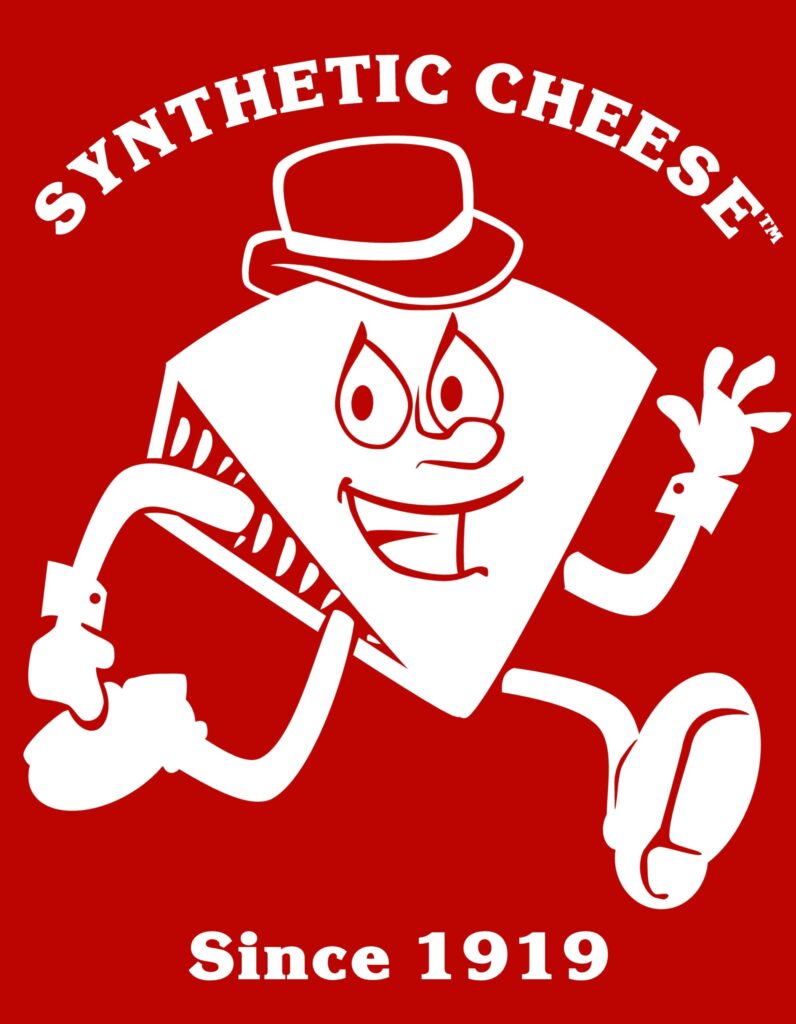
The character that Dan and I created, in the vein of Mr. Butts and also with a little inspiration from Ren & Stimpy’s Powdered Toast Man, was an anthropomorphic cheese wedge, the spokesman for a brand called Synthetic Cheese, named Wedgie. He’s gone through several changes over the 32 years since we created him, but he’s basically still the same. He insists on the ubiquity and historical importance of his product. I even made the first History of Synthetic Cheese in 1995, when I was 15, most definitely inspired by Wonder Book of Rubber, though with admittedly less artistic flair than I wanted.
Flash forward to 2014. Dan and I live in different states – Dan is in Boise, Idaho, and at the time I was in Burbank, California (I’m now in Berkley). We start doing a podcast each week called “Dan and Jay’s Comedy Hour,” since that has always been the name of our sketch and improv concern. We do it to stay in touch, occasionally bringing back old characters and bits – between our bullshitting there’s a bit of improv. In the last eleven years on that show, it’s been made evident that Dan is actually podcasting from 30 years in the past (never mind how we had a shared childhood, that never comes up), we’ve been visited by Lizzie Borden and H.H. Holmes, and Dan eventually becomes steam-powered and may or not go back in time and become Jack the Ripper.
Within this construct, we’ve even started talking to our progenitors because, as it happens, our comedy group goes back to at least the 1860s, though Dan has recently forced it back as far as Ancient Greece. Along the way, our group’s comedy pieces were always sponsored by some form or another of Synthetic Cheese, the history of which I’ve also continued to expand upon. I’ve even started writing an entire book of the fake history of our sketch group, based upon the idea that perhaps we might be traveling back in time ourselves to make it so that history has no choice but to remember us, even if we have to chronicle it ourselves. The phrase “hell hath no fury like a woman scorned” was invented to throw the scent off the scorner. Never underestimate the power of outdated things – and men – insisting they are important.
I don’t know if it’s more or less damning that we stumbled upon this theme by accident – maybe it’s a symbol of growth that we even recognized it? Regardless, of the hundreds of hours of comedy Dan and I have created together, two feature films, several comedy albums – and a cylinder phonograph that we recently had cut – this whole fake history is my favorite thing we’ve ever done. It manages to encompass it all, deny much of it, make it all worthless, and give it value all at once. After all, if we sparked the first group to become performers in 1860, then we’ve made our own fate as relatively unknown comedians happen ourselves, with no one else to blame. If all we have left at the end is our version of Wonder Book of Rubber, then technically we’ve done our job.